








Upholding information integrity in the digital age
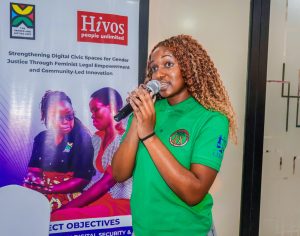
The Gender and Justice Unit (GJU) joined stakeholders in Lilongwe for the fourth Annual Media and Access to Information Conference (AMATIC) 2026, which the Media Council of Malawi, the Malawi Human Rights Commission (MHRC), GJU and the Centre for Human Rights and Rehabilitation (CHRR) jointly organised. GJU took part in partnership with MHRC through the Hivos-supported project “Strengthening Digital Civic Spaces for Gender Justice Through Feminist Legal Empowerment and Community-Led Innovation,” funded by NORAD – the Norwegian Agency for Development Cooperation.
Under the theme “Upholding Information Integrity in the Digital Age: The Role of Access to Information in Addressing Information Disorder,” the conference brought together government institutions, media professionals, civil society organisations, human rights actors, law enforcement agencies, Parliament, academia, youth innovators and information-rights advocates to examine Malawi’s changing information environment. The gathering also formed part of the activities marking the 2026 International Day for Universal Access to Information.
Participants explored how access to reliable public information can counter the growing challenge of misinformation, disinformation and manipulated content in digital spaces, and they stressed the importance of proactive disclosure, ethical journalism, digital literacy, responsible use of artificial intelligence and stronger public accountability.
Speakers also highlighted the role public institutions play in ensuring that citizens can obtain timely and accurate information. The guest of honour, Minister of Information and Communications Technology Dr. Shadric Namalomba, called on these institutions to strengthen their compliance with the Access to Information framework through proper records management, proactive disclosure, updated information manuals and timely responses to information requests. The Minister also visited the GJU booth, where GJU staff member Sheena Majawa introduced him to our work.
Pabwalo dialogue: “Whose Voice Counts?”
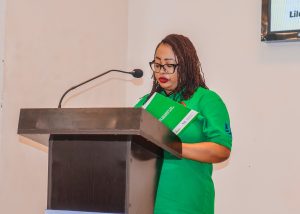
The highlight of GJU’s participation was the Pabwalo dialogue, “Whose Voice Counts? Gender, Intersectionality and Digital Rights in the Information Ecosystem,” which GJU Board Chairperson Lynda Ndovie-Jere moderated. The panel brought together:
- Honourable Rhita Sanga, Vice Chairperson of the Parliamentary Committee on Media and Information Technology
- Counsel Linda Luwayo Zinjani, Senior State Advocate in the Ministry of Justice
- Superintendent Gift Likoswe, Victim Support Unit Desk Officer at National Police Headquarters
- Yvonnie Akonda Sundu, Communication Specialist and Media Professional
- Chimwemwe Mwafulirwa, representing the Dedza CSOs Network
The panel brought a gender and community lens to the wider conference debate, asking how citizens access public information, what they can do when institutions ignore their requests, how survivors of gender-based violence learn about progress on their cases, and how society can protect women from violence and abuse in digital spaces.
“Malawians have the right to know”
Speaking on access to development information, Hon. Rhita Sanga emphasised that citizens have a right to understand how leaders make decisions that affect their communities and how institutions implement development projects. She urged communities to start by seeking information through local development structures, including Village Development Committees (VDCs), Area Development Committees (ADCs) and Community Development Committees (CDCs), before taking their concerns to councils and other authorities.
“Malawians have the right to know,” Sanga said, stressing that information must reach communities at every stage of the development process.
She also pointed to Parliament’s oversight role, explaining that citizens can raise concerns when public institutions withhold information and that parliamentary committees can then call the officials responsible to account. “We do summon whoever is denying citizens their rights, and they come before us,” she said. “After the meeting, we write reports and make them public.”
Sanga acknowledged that citizens need clearer procedures when they struggle to obtain information, and she said Parliament is engaging other stakeholders, including the Malawi Human Rights Commission, on the issue.
Challenging non-response
Counsel Linda Luwayo Zinjani set out the routes citizens can take when an institution refuses or ignores a request made under the Access to Information framework. An applicant can first ask the information holder for an internal review; if that fails to resolve the matter, the applicant can request a review by the Malawi Human Rights Commission and, as a final step, approach the courts.
The discussion underlined the need for a process that citizens can easily understand, and participants called for a simplified, publicly available procedure so that people know exactly what to do when an institution fails to respond.
The panel also urged public institutions to disclose information proactively rather than wait for citizens to request every piece of it, naming budgets, policies, manuals, contracts and relevant reports as essential to public accountability. This message echoed the wider AMATIC discussions, where participants pressed public institutions to embrace proactive disclosure and build stronger information management systems.
Journalists urged to pursue unanswered information requests
Yvonnie Sundu urged journalists and citizens not to abandon information requests simply because an institution stays silent. She encouraged applicants to follow up through letters, emails, telephone calls, WhatsApp messages or visits to the relevant information offices and, when those efforts fail, to use the internal review mechanism and seek help from the Malawi Human Rights Commission where necessary.
Sundu also challenged journalists to turn institutional non-response into public-interest reporting. “The other way that I have seen a number of times, but as journalists we have not exploited that much, is being able to write stories that expose institutions that are sitting on ATI,” she said. Such stories, she explained, can document how institutions ignore legitimate requests, particularly when the public has a strong interest in the information.
Information integrity in the age of AI
The dialogue then linked access to information with the wider challenge of information integrity. Sundu named verification as one of the media’s most important responsibilities: “The biggest issue that we have right now is publishing verifiable information,” she said.
She called for stronger media and digital literacy initiatives that help citizens recognise misinformation and question what they read before they share it, noting that the line between verified professional journalism and unverified content on digital platforms now matters more than ever.
Sundu also warned about the risks that artificial intelligence and manipulated content pose. “We are living in an era of AI. People are doctoring pictures, videos, audios,” she said, urging citizens to check the authenticity of information before passing it on.
Her contribution complemented the broader AMATIC conversation on ethical journalism, fact-checking, digital literacy and the responsible use of emerging technologies. Rights and media organisations involved in the conference have also called for stronger mechanisms to tackle misinformation and disinformation while protecting freedom of expression, privacy and media freedom.
Survivors’ right to information and online violence against women
The panel explored the gender dimension of information integrity by turning to survivors of gender-based violence and to online violence against women.
Superintendent Gift Likoswe, Victim Support Unit Desk Officer at National Police Headquarters, stressed that survivors have a right to know how their cases are progressing. He explained that the investigator usually becomes the first point of contact once a survivor reports a case and carries the responsibility of keeping the survivor and any witnesses informed. “The primary duty of the investigator is to inform either the witness or the survivor on the progress of the case,” Likoswe said. When a case moves to prosecution, he added, prosecutors take on that duty too, updating survivors and witnesses on court dates and developments and preparing them for court procedures.
The discussion then moved to the harassment, intimidation, body shaming and other abuse that women face in digital spaces. Likoswe encouraged women who experience online abuse to report it formally to the police, explaining that a formal report allows investigators to engage directly with victims and act while protecting their confidentiality and privacy. “Actions will be taken when that report has been formally reported,” he said.
He also urged the media, civil society organisations and other stakeholders to flag online abuse cases to the police, because incidents that circulate on social media do not necessarily reach investigators through formal channels. Likoswe acknowledged that the police face capacity challenges in handling cyber-related offences, and he called for continued awareness-raising and stronger investigative capacity.
Collective responsibility for safer digital spaces
The panel agreed that the police cannot tackle online violence alone. Likoswe called on all stakeholders to work together so that women enjoy protection in digital spaces and victims know where to seek help. “When I talked about formal reporting, we want to reach this particular victim that has been victimised. We want to tell her about her rights. We want her to know that she has been victimised and she can be assisted,” he said. He closed with an appeal to the media, human rights actors, civil society organisations and the wider public: “As stakeholders, as Malawi at large, let’s work together to ensure that women are safe on the cyberspace.”
The closing contributions reinforced the dialogue’s central message. The Ministry of Justice representative urged public institutions to share information without waiting to be asked: “Proactively provide information to the citizens. We shouldn’t wait for citizens to ask for information from the institutions.” She also encouraged citizens to engage their elected representatives: “One of the roles of the Members of Parliament is to represent people. We shouldn’t shy away from contacting them if we’re not sure of anything.”
Where access to information, digital rights and gender justice meet
The Pabwalo dialogue showed how access to information, digital rights and gender justice intersect in Malawi’s changing information ecosystem. While the wider conference examined national challenges such as information disorder, digital transformation, media freedom, public accountability and access to information, the Pabwalo discussion brought these issues closer to citizens’ everyday lives.
The conversation made clear that access to information depends on more than laws and information systems. It also depends on whether communities know where to seek information, whether institutions answer legitimate requests, whether citizens can challenge silence, and whether women and marginalised groups can participate safely in digital spaces.
For GJU, AMATIC 2026 offered a platform to bring a feminist perspective to national conversations on information integrity and digital rights. Through the Pabwalo dialogue, GJU connected public accountability and access to information with the protection of women from online violence and the need for inclusive participation in digital civic spaces.
Ultimately, the discussions highlighted that citizens, public institutions, Parliament, the justice sector, the police, the media, civil society, academia and technology actors share responsibility for building an information environment that is accessible, credible, accountable and inclusive.
About the project
GJU took part in AMATIC 2026 through “Strengthening Digital Civic Spaces for Gender Justice Through Feminist Legal Empowerment and Community-Led Innovation,” a project GJU implements in partnership with the Malawi Human Rights Commission, with support from Hivos and funding from NORAD.
Hivos is an international development organization that contributes towards just, inclusive and life-sustaining societies, where people have equal access to opportunities, rights and resources. Hivos’ approach is solution-driven, and it builds wider movements for change by amplifying and connecting voices.